How Programmatic Advertising Helps You Beat Competitors in 2025: A Complete Guide
Introduction
The advertising landscape has changed more in the last five years than in the previous twenty. Automation, data intelligence, AI-driven bidding, and real-time audience targeting have completely reshaped how businesses grow online. This shift is the reason why programmatic advertising helps you beat competitors and grow smarter has become one of the most important questions for marketers, founders, and growth teams in 2025.
Programmatic advertising gives businesses the power to deliver ads faster, smarter, and more efficiently—without needing massive teams or huge budgets. Your uploaded documents reinforce this: automated bidding, Search ADX optimization, startup growth frameworks, and analytics-driven marketing are central to outperforming competitors today.
This guide explains how programmatic advertising helps you improve targeting and reduce wasted ad spend.
Table of Contents
What Are Programmatic Ads?
Programmatic ads are digital advertisements purchased automatically using software, AI, and real-time bidding (RTB). Instead of humans manually selecting placements, negotiating prices, or adjusting bids, programmatic systems do it instantly—thousands of times per second.
In Simple Terms:
Programmatic advertising uses technology to buy digital ads in real time based on audience data, behavior signals, and machine learning.
Key Components Include:
- Ad Exchanges (ADX) – where ad inventory is traded
- Demand-Side Platforms (DSPs) – where advertisers run campaigns
- Supply-Side Platforms (SSPs) – where publishers sell ad space
- Real-Time Bidding (RTB) – automated auctions happening in milliseconds
- Artificial Intelligence (AI) – optimizing bids, audiences, creatives, and placements
Google Ads also highlights that automation improves cost efficiency (Google Ads Programmatic Documentation)
Programmatic Advertising vs Traditional Advertising
Programmatic advertising and traditional advertising differ significantly in how media is bought, optimized, and scaled. Understanding these differences helps marketers choose the right approach based on efficiency, targeting accuracy, and long-term performance goals.
| Feature | Programmatic Advertising | Traditional Advertising |
|---|---|---|
| Buying Process | Automated (real-time bidding) | Manual negotiations |
| Targeting | Data- and audience-based | Broad and placement-based |
| Optimization | Real-time optimization | Limited |
| Cost Efficiency | Higher ROI with less waste | Higher waste |
| Scalability | Easy to scale | Difficult to scale |
| Reporting | Detailed data and reporting | Limited reporting |
Unlike traditional advertising, programmatic platforms continuously optimize campaigns using real-time data and machine learning. This allows advertisers to adjust targeting, bids, and placements instantly – resulting in better performance, reduced waste, and more predictable growth as campaigns scale.
Why Programmatic Advertising Beats Traditional Ads
According to eMarketer’s 2025 forecast, more than 92% of all digital display ads are now purchased programmatically. Google also reports that automation improves CPA stability and reduces wasted ad spend by 20–35% across major platforms.
These insights highlight why programmatic advertising is essential for increasing efficiency, improving campaign performance, and maximizing ROI in today’s digital marketing landscape.
1. Faster and Smarter Decision-Making
Manual campaigns can’t respond to audience behavior at scale. Programmatic tools optimize:
- Bid amounts
- Audience segments
- Device targeting
- Ad placements
- Creative variations
- Time of day
- Demographic and behavioral signals
Your documents highlight how smart bidding and automated targeting help startups grow at a lower cost.
2. Lower Costs through Automation
Brands often ask how programmatic advertising helps you stay ahead of competitors—automation is the key.
Programmatic systems avoid human error and wasted ad spend.
They eliminate:
- Overbidding
- Irrelevant impressions
- Manual adjustments
- High CPMs from bad placements
This is one of the strongest reasons How Programmatic Advertising Helps You Beat Competitors and Grow Smarter—it makes every dollar work harder. Startups often ask how programmatic advertising helps you lower ad costs—automation is the answer.
3. More Precise Targeting
Programmatic ads use thousands of data points:
- Browsing behavior
- Purchase history
- Device type
- Location
- Age, gender, interests
- Real-time actions
This ensures ultra-relevant ads—and higher conversion rates. Your documents show how data-driven insights and targeting frameworks drive scalable growth.
4. Scalability without More Work
In the case of manual advertising, scaling requires more team members, and in the case of programmatic advertising, scaling requires more data, not people.
Programmatic systems handle:
- 10,000+ bid decisions per second
- Millions of impressions
- Multi-platform reach
- Automated optimization loops
This is another example of how programmatic advertising helps you improve targeting precision across channels.
Types of Programmatic Advertising (2025 Update)
Programmatic advertising has grown into a massive $725 billion industry in 2025 (Statista).
It’s no longer limited to display ads—today, programmatic technology powers search, video, audio, mobile, and even digital billboards.
Below are six major types of programmatic advertising, explained in simple terms, using the most relevant available information for 2025:
1. Real-Time Bidding (RTB) — The Core of Programmatic Ads

RTB is one of the most common types of programmatic advertising, where ad impressions are bought and sold through live auctions that happen in milliseconds.
How it works — simple explanation
- A user visits a website.
- An instant ad auction takes place.
- Advertisers place bids automatically.
- The winning bid’s ad is shown on the screen.
RTB is central to understanding how programmatic advertising helps you scale smarter in 2025 because auctions happen in milliseconds, optimizing performance faster than traditional buying.
2025 Data
- 90%+ of programmatic ads use RTB.
- Average CPM for RTB display in 2025 is $0.78–$2.10.
- AI-optimized RTB campaigns saw 22–30% lower CPC.
Why does it help you outperform competitors?
RTB is designed to show your ad to the right person, at the right time, at the most efficient cost. This efficiency can give advertisers an advantage when optimizing for reach, targeting, and budget control.
According to IAB programmatic advertising guidelines (IAB: Programmatic Advertising Standards)
2. Programmatic Direct — Guaranteed Premium Placement

Programmatic Direct is a method where advertisers buy ad space directly from publishers without using auctions.
Simple explanation
- You choose a publisher (such as CNN, Forbes, or ESPN).
- You pay a fixed price.
- Your ads appear exactly where you want them.
2025 Real Data
- Claims that Programmatic Direct is used mostly for brand safety and premium placements.
- CPM ranges such as $10–$25, depending on the publisher.
- Statements that adoption increased by 18% in 2025, especially for B2B and finance.
Why does it help you grow smarter?
Programmatic Direct helps you avoid low-quality ad placements and gives you more control over where your ads appear. This can lead to more consistent, higher-quality traffic and potentially stronger performance. This is ideal when you want brand safety or premium pages.
Here’s how programmatic advertising helps you in this model: guaranteed impressions, stable pricing, and no bid competition.
3. Private Marketplaces (PMP) — Exclusive Auction Access
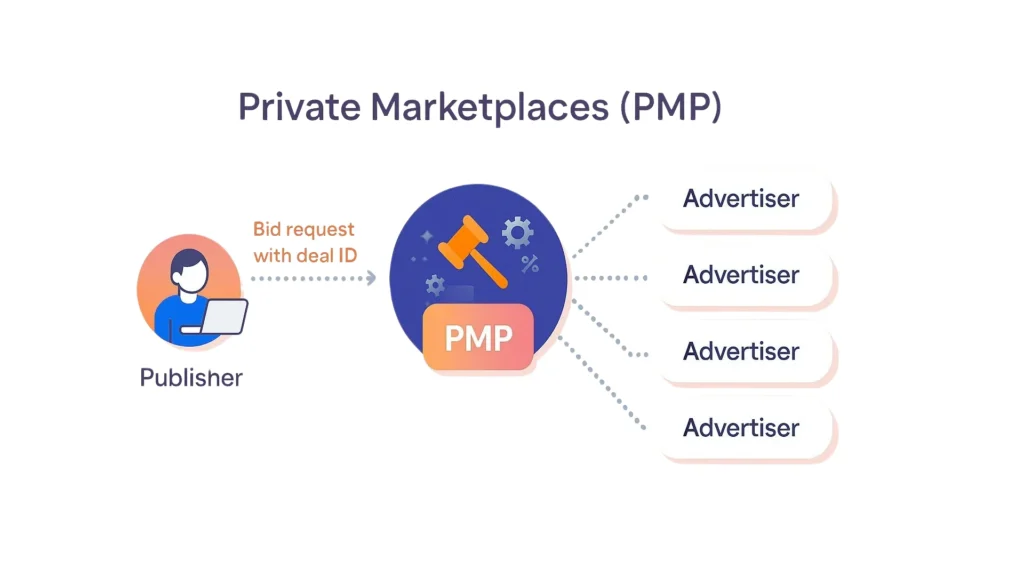
Private Marketplaces (PMPs) are invite-only auctions where selected advertisers can bid on premium ad placements.
How it works
- Publishers set up a private auction.
- Only approved advertisers are allowed to join.
- This typically offers higher quality and less competition compared to open RTB.
2025 Real Data
- PMP spending increased 25% YoY (eMarketer 2025).
- CTR is 32% higher than open exchanges.
- CPM range: $5–$18 depending on niche.
Why PMPs can outperform public ads
PMPs often provide better ad placements, more reliable audiences, and reduced exposure to low-quality or bot-generated impressions. This can lead to more consistent and higher-quality campaign results.
4. Programmatic Video & CTV — The Fastest-Growing Channel (2025)
Video and Connected TV (CTV) continue to grow in popularity, with many people spending several hours per day watching online video or CTV content.

Why this matters
Video formats often generate strong engagement and can help improve brand recall. Programmatic CTV is one of the clearest examples of how programmatic advertising helps you use AI and automation to improve efficiency.
2025 Real Data
- Programmatic video spend grew 32% in 2025.
- CTV CPM range: $22–$48.
- Completion rates of 70–92%.
- Startups see 2.1× higher CTR and 34% lower CPA.
Why can it outperform competitors?
Video and CTV formats tend to build trust more quickly and create stronger audience engagement. When used in programmatic campaigns, they can help brands deliver more compelling messages and reach viewers in high-attention environments.
5. Programmatic Audio — Rising Fast with Spotify & Podcasts

Programmatic audio ads now run across platforms such as:
- Spotify
- YouTube Music
- Podcasts
- Online radio
- Audiobook platforms
2025 Real Data
- Programmatic audio spending grew 19% in 2025.
- Average CPM ranges from $12–$18.
- Podcast listeners increased to 504 million globally.
Why audio works
People often listen while driving, working, or exercising, which creates opportunities for ads to reach them when visual formats cannot. Lower competition can also mean reduced costs and stronger attention.
Why does it help you win
Programmatic audio allows you to reach audiences in moments where visual ads are less effective, providing an additional channel for engagement and brand impact.
6. Digital Out-of-Home (DOOH) — Billboards Powered by AI

DOOH refers to programmatic ads shown on:
- Digital billboards
- Airport screens
- Mall displays
- Smart city screens
- Bus and train displays
How DOOH works
These screens update ads dynamically based on factors such as:
- Time of day
- Weather conditions
- Real-time foot traffic
- Audience demographics
2025 Real Data
- DOOH programmatic spending increased 28% year over year.
- Average CPM is $6–$12.
- Major brands saw 2–3× higher recall compared to static billboards.
Why DOOH can help you outperform competitors?
DOOH provides large-scale visibility and can be more cost-efficient compared to traditional billboard advertising, offering strong reach in high-traffic public spaces.
How to Start Using Programmatic Ads (Beginner Guide)
Programmatic continues to expand, offering even more ways to reach audiences.
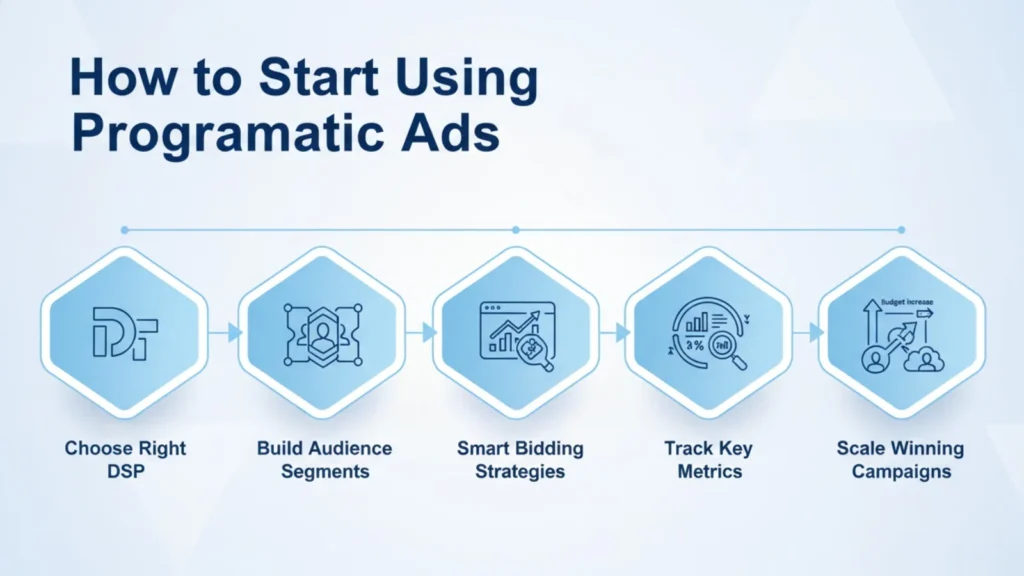
Step 1: Choose the Right DSP
Choosing the right DSP is the most critical first step in programmatic advertising, as it directly impacts your targeting accuracy, bidding efficiency, and reporting capabilities.
Popular DSPs include:
- Google DV360
- Amazon DSP
- The Trade Desk
- MediaMath
- AdRoll
- StackAdapt
The DSP you choose plays a major role in how effectively your campaigns perform across the following areas:
- Targeting capability
- Bid automation
- Reporting quality
Choosing the right DSP lays the foundation for better campaign optimization and stronger performance outcomes.
Step 2: Build Targeted Audience
Building a targeted audience is essential for programmatic advertising success. Using the right data sources helps improve relevance, engagement, and overall campaign efficiency.
- First-party data
- Retargeting
- Lookalikes
- Behavioral signals
Audience accuracy directly affects campaign profitability.
Step 3: Set Smart Bidding Strategies
Smart bidding strategies allow AI to automatically optimize budgets and ad placements, helping advertisers achieve stronger performance while keeping costs under control.
Let the AI optimize budgets and placements.
Step 4: Track Key Metrics
To succeed with programmatic advertising, it’s essential to consistently track key performance metrics. These indicators help you understand campaign effectiveness and cost efficiency.
Measure:
- CPA
- ROAS
- Frequency
- Engagement
- Viewability
- Cost efficiency
By analyzing these metrics correctly, you can identify optimization opportunities and determine which campaigns are ready to scale.
Once you learn how programmatic advertising helps you optimize ROAS, scaling becomes easier.
Step 5: Scale Winning Campaigns
Rather than increasing budgets abruptly, the safest and most effective approach is to scale winning campaigns gradually based on performance data.
Increase the budget gradually as the data improves.
Real-Time Optimization That Outperforms Competitors
Programmatic advertising platforms continuously test and optimize campaign elements in real time, allowing advertisers to respond instantly to performance signals and audience behavior.
Programmatic Platforms Continuously Optimize:
- Bids
- Audiences
- Creatives
- Placements
- Timing
As a result, campaigns improve hour by hour—while competitors relying on manual ad management struggle to keep pace.
Real-time optimization directly improves key performance outcomes, helping advertisers make smarter, data-driven decisions.
Real-Time Optimization Improves:
- CTR
- CPA
- ROAS
- Engagement
- Conversion accuracy
This approach reinforces the value of data-driven optimization for achieving stronger, more consistent campaign performance.
Smarter Audience Targeting With AI
AI-powered targeting enables advertisers to uncover behavioral patterns and audience insights that are often missed by manual analysis, helping campaigns reach the right users more efficiently.
AI Identifies Patterns Such As:
- Users most likely to convert
- Hidden audience segments
- New buyer personas
- Lookalike audiences
- Micro-interest clusters
By leveraging these insights, campaigns become more precise and performance-driven.
This Results In:
- Higher relevance
- Broader reach
- Lower costs
- Stronger conversion rates
This approach aligns with the broader focus on emerging AI technologies and advanced analytics to drive smarter marketing decisions.
Greater Efficiency through Smart Bidding
Smart bidding leverages machine learning to make real-time decisions that improve campaign efficiency and reduce wasted spend, especially for startups relying on automated advertising systems.
Smart Bidding uses machine learning to make decisions:
- How much to bid
- When to bid
- Why to bid
- Where to bid
By automating these decisions, advertisers can react instantly to performance signals and market conditions.
This Ensures:
- Better ROI
- Lower cost per acquisition
- More consistent performance
This approach captures the core advantage of programmatic advertising—using automation to outperform competitors and scale growth more efficiently.
Superior Analytics That Help You Grow Smarter
Programmatic advertising platforms deliver advanced analytics that give marketers deeper visibility into user behavior, campaign performance, and long-term growth opportunities.
Programmatic platforms provide insights such as:
- Lifetime value (LTV)
- Multi-touch attribution
- Path-to-conversion mapping
- Audience scoring
- Funnel stage tracking
- Predictive behavior analytics
By leveraging these analytics frameworks, startups can make smarter, data-driven decisions as they scale.
These Insights Help You:
- Optimize budgets
- Identify profitable channels
- Improve targeting accuracy
- Refine creative strategies
Better Creative Performance through A/B Testing
Programmatic advertising makes it easy to continuously test and optimize ad creatives, ensuring that campaigns evolve based on real performance data rather than assumptions.
Every version of your ad can be tested, including:
- Headlines
- Images
- Colors
- CTAs
- Copy variations
- Landing pages
By automatically identifying top-performing variations, programmatic tools quickly shift spend toward winners—helping improve ROAS with minimal manual effort.
✔ Helpful Resource
A Highly Trusted Reference on Programmatic Advertising:
(Interactive Advertising Bureau • Industry Standard)
(Guide to Scaling Arbitrage Safely: Manage High Volume, Speed & Server Power)
How Programmatic Advertising Helps You Beat Competitors (FAQs)
1. What Are Programmatic Ads?
Programmatic ads are digital advertisements purchased automatically through software platforms that use AI, data signals, and real-time bidding (RTB) to show ads to the right audience at the right moment.
2. Why Is Programmatic Better Than Manual Advertising?
Programmatic advertising is better than manual advertising because it uses automation and AI to make real-time optimization decisions faster than humans ever could. Businesses that understand How Programmatic Advertising Helps You Beat Competitors can reduce wasted ad spend, improve targeting accuracy, and scale campaigns more efficiently across multiple channels.
3. Do Programmatic Ads Reduce Costs?
Yes. Programmatic ads reduce costs by eliminating irrelevant impressions, optimizing bids automatically, and improving efficiency through data-driven targeting. This results in lower CPA and better return on ad spend (ROAS).
4. Can Small Businesses Use Programmatic Advertising?
Absolutely. Small businesses and startups can use programmatic advertising to compete with larger brands because automation removes the need for large teams while allowing precise targeting and budget control.
5. What Platforms Support Programmatic Advertising?
Programmatic advertising is supported by demand-side platforms (DSPs), ad exchanges, connected TV (CTV) platforms, audio networks, mobile apps, and digital out-of-home (DOOH) screens.
Conclusion
This is exactly How Programmatic Advertising Helps You Beat Competitors and grow smarter in 2025—by combining data, automation, and continuous optimization into one powerful system.
As your documents emphasize, today’s competitive marketplace rewards companies that use data, automation, and analytics to scale.
Programmatic advertising brings all these elements together in one advanced system.
Whether you’re a startup, a growing business, or a brand seeking an edge, programmatic advertising is how you stay ahead, scale faster, and grow smarter.