Guide to Scaling Arbitrage Safely: Avoid These 7 Deadly Mistakes When Increasing Volume
Introduction
Arbitrage appears deceptively simple. Traders buy low and sell high—often within seconds—then repeat the process. Many achieve success on a small scale and require upgrading the entire trading operation. However, this assumption is usually the quickest way to undermine an otherwise profitable strategy.
As Golam Kibriya explains through real-world trading system analysis, scaling arbitrage safely does not involve simply placing larger orders. It requires upgrading the entire trading operation—technology, operational logic, risk management, and compliance—before increased trading volume exposes hidden weaknesses. At low levels, inefficiencies remain latent; at high volumes, they can become catastrophic.
This guide outlines the seven most serious mistakes traders make when increasing arbitrage volume and demonstrates how to scale operations in a controlled, data-driven manner without compromising competitive advantage.
Table of Contents
What This Guide Covers About Scaling Arbitrage Safely
This Guide is Designed for:
- Crypto, Forex, and Equity Arbitrage Traders
- Retail/E-Commerce Arbitrage (Amazon, Marketplace)
- Traffic and Advertising Arbitrage (Media Buying, CPC Arbitrage)
- Quant, Alg,o and HFT-Style Traders Upgrading Their Stack
If you’re processing more signals, more trades, and more volume than ever before – and you want to stay profitable, consistent, and stable – then you’ve come to the right place.
What Is Arbitrage at Scale?
In Golam Kibriya’s high-frequency trading workflow, a trader spots an opportunity: prices on Exchange A and Exchange B show a small but exploitable differential. The clock starts ticking as competing traders rush to capitalise on the gap. Orders are executed in rapid succession, and just as quickly, the profit window narrows or disappears.
- Multiple exchange order books
- 10,000+ price updates per second
- Hundreds of API calls per minute
- Split-second execution logic
- Heavy server loads and sustained network traffic
As you scale, even millisecond-level delays or minor errors can lead to significant losses. Therefore, safe scaling isn’t just about increasing trade volume—it’s about engineering robust systems, managing operational risk, and optimising performance to withstand the increased complexity and pressure.
Why are Milliseconds Important?
Latency—the delay between issuing a command and its execution—is one of the most critical factors affecting arbitrage profitability. In high-frequency environments, even a delay of 5 to 20 milliseconds can wipe out an entire profit margin.
When you scale arbitrage operations, you are not merely increasing volume—you are also scaling:
- Latency Risk
- Liquidity Risk
- Technical Risk
- Compliance Risk
The rest of this guide explores how to manage these risks effectively—so you can grow without losing your edge.
Understanding High-Volume Trading at Scale

High-volume arbitrage requires fast, automated trade execution across multiple exchanges – a key component of safe arbitrage scaling and maintaining stable profitability.
This approach involves executing large volumes of trades across multiple locations to profit from small price differences. Unlike basic retail strategies, it requires fast execution, robust server performance, and overall system stability to handle significantly high transaction loads. This level of accuracy and reliability is essential to maintaining consistent profitability under heavy throughput.
It usually involves:
- Acting fast across different order books
- Handling a heavy server workload
- Using very fast market data
- Working with tiny price gaps
- Relying on automation to make split-second decisions
A typical high-volume arbitrage process looks like this:
- Spot a price difference between two or more exchanges
- Buy the asset on the exchange where the price is lower
- Sell it right away on the exchange where the price is higher
- Lock in the profit before the gap closes
The 7 Deadly Mistakes When Increasing Arbitrage Volume
Let’s go through the most dangerous mistakes traders make when they try to scale—and how to avoid each one.
Mistake 1: Scaling Volume Too Fast
The number one reason arbitrage strategies collapse is aggressive, untested scaling.
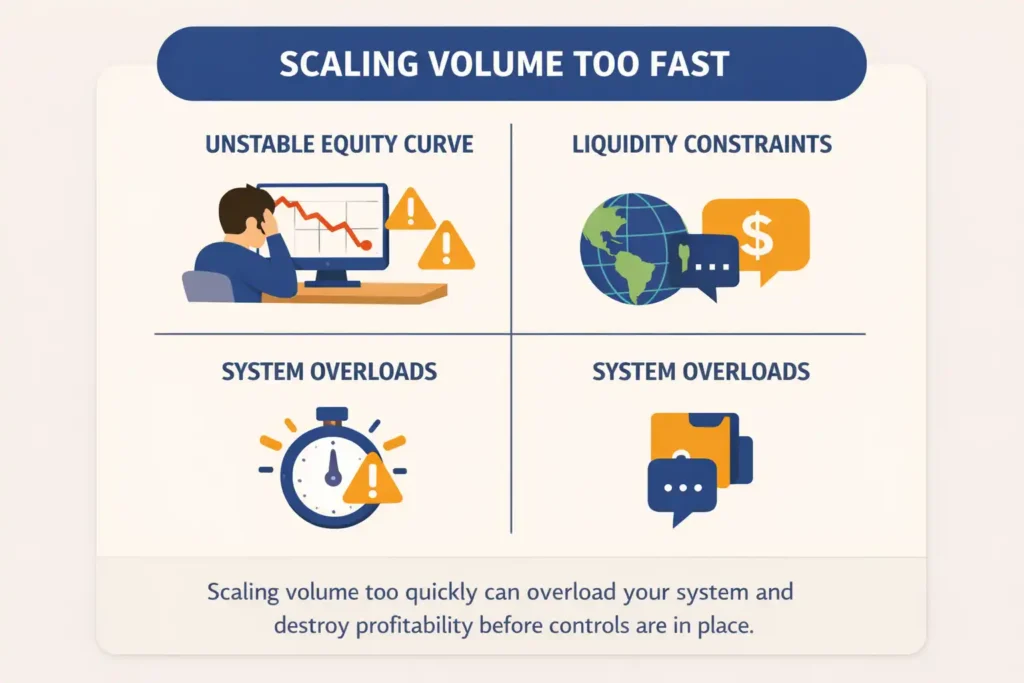
When traders double or triple size overnight, they introduce multiple risks at once:
- Execution delays
- Slippage amplification
- Infrastructure overload
- Liquidity mismatches
Instead, professional operators use phased scaling.
The 10–20% Rule
A proven approach is to increase volume by 10–20% per cycle, then observe:
- Latency changes
- Fill quality
- Error rates
- Net profitability
If metrics remain stable, scale again. If not, pause and fix the bottleneck. Scaling is not linear—it is adaptive.
Mistake 2: Ignoring System Overload & Server Limits
At higher volume, your trading system stops being “software” and starts behaving like infrastructure.
- CPU at 100%
- RAM Saturation
- Packet Loss on Network Cards
- Order-Book Processing Delays
- API Timeouts
All of these directly cause missed trades, false signals, and crashes.
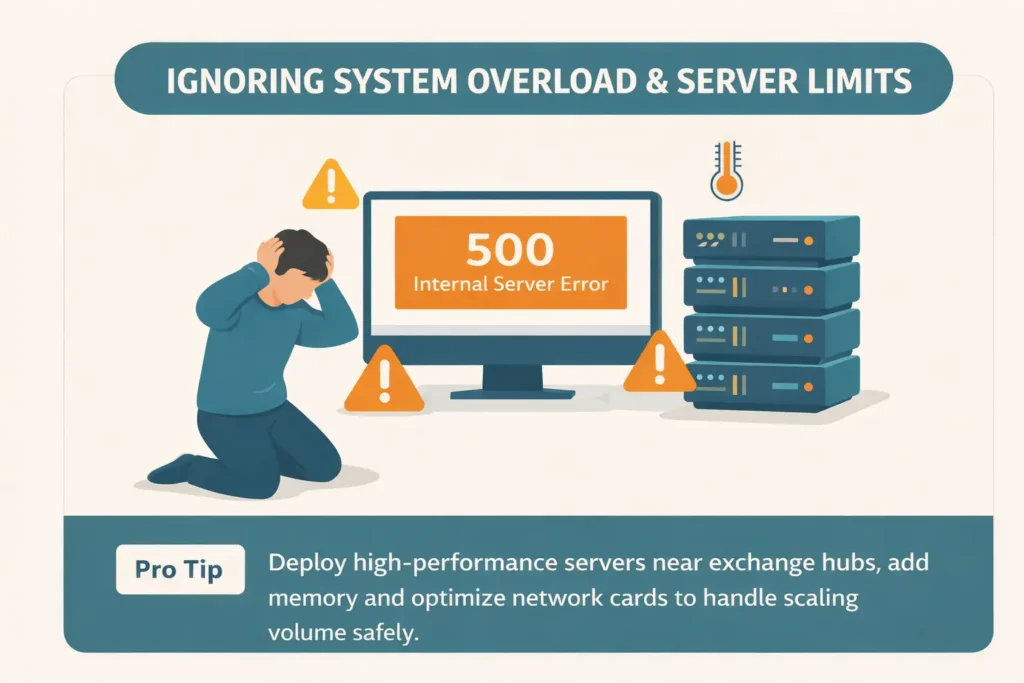
How to fix it (Server Power Upgrades):
- Use bare-metal servers instead of overloaded VPS.
- Choose high-frequency CPUs with strong single-core speed.
- Add large RAM to handle multiple order books.
- Use low-latency network interface cards (NICs).
- Deploy multi-location servers (US, EU, Asia) close to different exchanges.
Mistake 3: Trusting a Single Slow Data Feed
When you scale, you rely heavily on the quality and speed of your data. Slow or stale feeds generate phantom signals—fake arbitrage opportunities that disappear by the time you execute.

These are caused by:
- Latency gaps between exchanges
- Cached or delayed API responses
- Poor timestamp synchronisation
How to fix it (Multi-Feed Verification):
- Use multiple data feeds for the same asset.
- Compare order-book depth across exchanges before executing.
- Implement timestamp accuracy (GPS/NTP/PTP sync).
- Build automated checks to flag stale ticks and discard them.
Mistake 4: Underestimating Liquidity Risk
A trade can look profitable on your screen, but if the order book is thin, scaling volume will simply wipe out the spread through slippage.
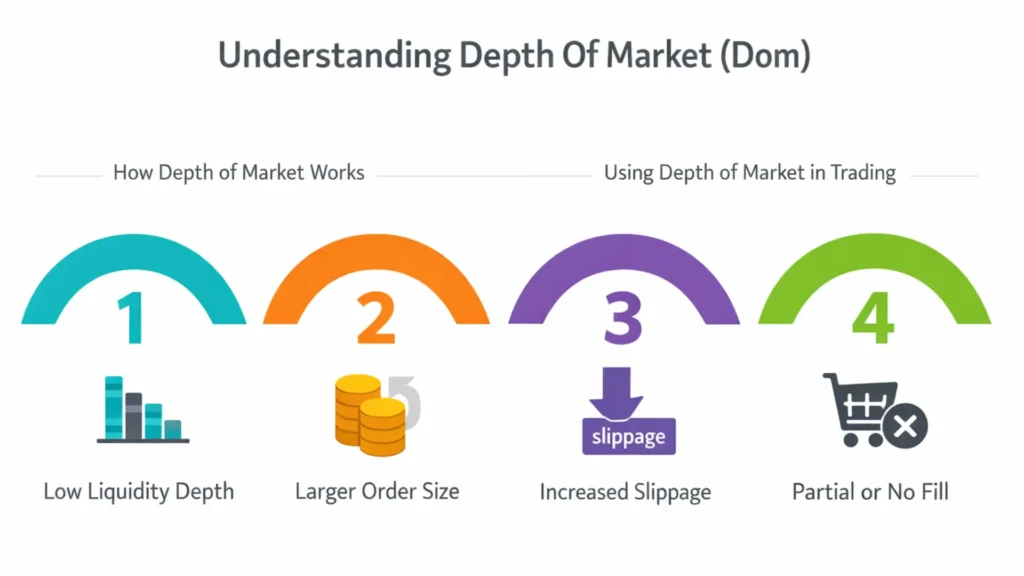
At higher volume, you’ll see:
- Larger Slippage
- Partially Filled Orders
- Profit Margins Collapsing
- Spreads Vanish During Execution
During events like NFP or CPI, liquidity depth across top forex ECNs can drop by 40–55%, making large arbitrage trades extremely dangerous.
How to fix it (Liquidity-Aware Scaling):
- Continuously monitor market depth (DOM).
- Only increase position size when there’s sufficient book depth.
- Use volume-based scaling models—tie your size to available liquidity.
- Route orders across multiple venues for better fills.
Mistake 5: Neglecting Execution Speed & Routing
If you’re still relying on basic HTTP polling for prices or slow APIs, scaling will simply magnify your latency and error rates.

Symptoms:
- You see opportunities but “miss the price” constantly.
- Orders fill at worse prices than expected.
- Many trades come back as “rejected” or “too late.”
How to fix it (Execution Upgrade):
- Use WebSocket feeds instead of REST polling for live prices.
- Implement FIX API for professional-grade, low-latency execution.
- Reduce network hops between your system and exchanges.
- Use co-location services where possible.
- Choose low-latency network providers optimised for trading.
Why Execution Infrastructure Matters at Scale
Mistake 6: Relying on Manual Processes at High Volume

Manual adjustments may work at a small scale—but high-volume arbitrage needs automation and AI to stay fast, accurate, and consistent.
Without automation, you get:
- Slow Reactions
- Human Error
- Missed Windows
- Burnout and Inconsistency
How to fix it (Automation & AI):
- Automate pricing, routing, inventory, and campaign optimisation (in retail or traffic arbitrage).
- Use bots for trade execution instead of manual clicking.
Incorporate AI / ML models to:
- Scan markets for anomalies
- Predict likely arbitrage windows
- Filter out low-quality signals
Automation lets you scale volume without scaling chaos.
Mistake 7: Ignoring Costs, Compliance & Platform Policies
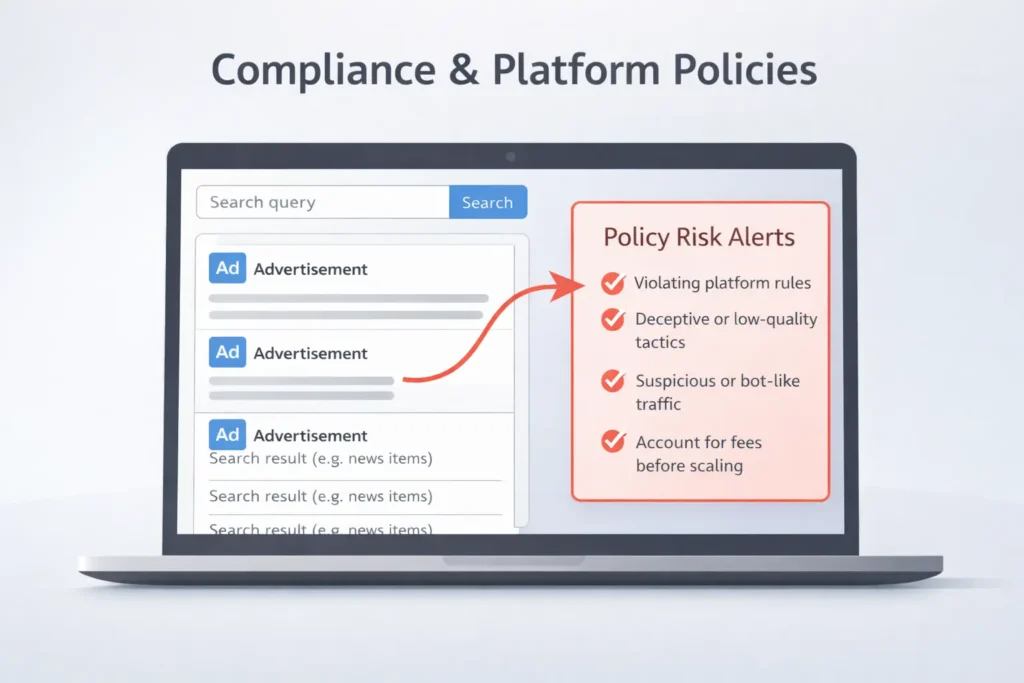
At high volume, even small fees or policy issues can kill your operation.
Cost risks:
- Transaction Fees
- Borrowing Costs
- Network Fees
- Slippage
- Hidden Platform Costs
Compliance risks (especially for retail & traffic arbitrage):
- Violating platform rules (e.g., Google, Amazon)
- Using deceptive or low-quality tactics
- Generating suspicious or bot-like traffic
How to fix it (Discipline & Compliance):
- Account for every cost before scaling.
- Only scale strategies with true net profitability after fees.
- Diversify traffic sources, suppliers, and platforms.
- Follow all platform terms & policies strictly.
- Reinvest profits gradually instead of going “all-in.”
This is how you protect your long-term edge.
A Step-by-Step Framework for Safe Arbitrage Scaling Growth
Scaling arbitrage profitably isn’t just about faster execution or doing more volume. As your operation grows, things like how you allocate capital, manage risk, and keep your systems stable become critically important. A lot of profitable arbitrage strategies fail — not because they stop working, but because they’re scaled too quickly.
This simple, step-by-step framework offers a safe, data-driven way to scale your arbitrage strategy. It helps reduce risk while supporting long-term growth. Whether you’re doing trading arbitrage, traffic arbitrage, algorithmic strategies, or e-commerce models, the same principles apply.

Step 1: Start Small and Test Live
The first step in scaling any arbitrage strategy is to validate it live, using tiny amounts of capital.
Forget about profits for now — the goal is to watch how the system behaves under real-world conditions.
Best Practices:
- Use tiny trade sizes or a minimal ad budget
- Run tests in real market or platform conditions
- Think of this phase as a system check, not a money-maker
Track These Daily:
- ROI (Return on Investment)
- Slippage (difference between expected and actual prices)
- Execution speed (latency)
- Fill rates or approval rates
- Errors, rejections, or failures
Goal:
Make sure your signals, execution, and infrastructure all work smoothly in a live environment.
Step 2: Look for Consistent Profits
Once your system runs without issues, let it operate for a while to see if the profits are real and repeatable.
What to Watch For:
- Steady performance over several days or weeks
- Profits that hold up under different conditions
- Patterns you can rely on — not just lucky wins
Do not increase the scale until:
- Bugs and errors are fixed
- Execution is stable
- Your numbers are consistent
Goal:
Prove that you’re profitable over time — not just on a lucky streak.
Step 3: Scale Slowly – 10–20% at a Time
If everything’s working and you’re seeing real profits, it’s time to scale — but go slow.
How to Scale:
- Increase your trade size, budget, or volume by 10–20%
- Do it weekly or every two weeks — not daily
- After each increase, check your performance again
Watch Out For:
- More slippage
- Falling ROI
- Slower executions
- System crashes or instability
If something breaks or performance drops, pause and troubleshoot right away.
Goal:
Make sure your system grows in step with your capital — not faster than it can handle.
Step 4: Add Automation and AI (Only If Ready)
Automation is powerful, but it should only enhance what already works — it shouldn’t be used to fix broken systems.
Good Uses for Automation:
- Repeating the same types of trades
- Enforcing budget and risk limits
- Setting up alerts and monitoring tools
How AI Can Help:
- Filter out weak or noisy signals
- Improve timing and execution
- Cut down on false positives
Golden Rule:
Don’t automate a system that isn’t already profitable and stable.
Goal:
Boost efficiency without adding unnecessary risk.
Step 5: Stress-Test Before You Scale Further
Before going big, make sure your system can handle pressure and peak loads.
Test Under:
- Higher traffic or trade volume
- Multiple trades are happening at the same time
- Unstable market conditions (like high spreads or volatility)
Measure These:
- CPU usage
- Memory (RAM) usage
- Network delays and execution lag
- Failure or timeout rates
Goal:
Find the limits of your system before your capital does.
Step 6: Build in Compliance and Quality
Long-term success in arbitrage depends on more than just profit — you also need to play by the rules and provide value.
Make Sure That:
- Your offers, trades, or products are legit and useful
- Your landing pages meet platform quality standards
- You follow the rules of the platforms you’re on
- You meet all regulatory or legal requirements
Remember:
Compliance isn’t a barrier — it’s a scaling advantage. Platforms and partners trust operations that play fair.
Goal:
Protect your system from being shut down, penalised, or banned.
Example Scaling Plan (Weekly)
| Optimise routing, feeds, and error handling | Volume Change | What to Monitor | Possible Action |
|---|---|---|---|
| 1–2 | Baseline (micro-volume) | ROI, latency, error rate, liquidity | Fix bugs, tune parameters |
| 3 | +10% volume | Slippage, server load, fill rates | If stable, keep volume; if not, roll back |
| 4 | +10–20% volume | API limits, rejected orders, stale signals | Optimize routing, feeds, error handling |
| 5 | +10–20% volume | Platform warnings, policy issues, CPC/fees | Adjust creatives, suppliers, or venues |
| 6+ | Maintain or small increases | Long-term ROI, drawdowns, and infrastructure health | Scale cautiously or consolidate |
If you plan to expand beyond startup-level traffic, make sure you’re prepared for the technical and operational risks that come with growth.
👉 Useful Reference:
Frequently Asked Questions (FAQs)
1. What Is High Volume Arbitrage?
Answer:
High-volume arbitrage involves executing large numbers of trades across multiple exchanges to capture small price differences. It requires fast execution, reliable infrastructure, and sufficient liquidity. Proper systems help scale volume without increasing operational risk.
2. How Quickly Should I Increase My Arbitrage Volume?
Answer:
Arbitrage volume should be increased gradually, typically by 10–20% per week. Scaling should only happen after confirming consistent profitability and system stability. This approach reduces technical and operational risk during growth.
3. Are Expensive Servers Necessary for Safe Scaling?
Answer:
Expensive hardware is not always required, but reliable low-latency infrastructure is essential. Stable servers, efficient CPUs, sufficient memory, and strong network performance matter most. These factors become critical for high-frequency or multi-exchange arbitrage.
4. Is Artificial Intelligence Required to Scale Arbitrage?
Answer:
AI is not mandatory for scaling arbitrage, but it can be highly beneficial. It helps analyse large data sets and detect opportunities or risks faster than manual or rule-based systems. This advantage becomes more important in fast-moving markets.
5. How Important is Compliance for Arbitrage?
Answer:
Compliance is critical for arbitrage, especially in retail and traffic-based models. Platforms may restrict or suspend accounts if policies are violated, which can disrupt operations at scale. Following platform rules and maintaining a high-quality user experience helps reduce these risks.
Conclusion
Scaling arbitrage in 2026 isn’t just about making bigger trades or processing more data — it’s about executing with precision, structure, and discipline. In this guide, Golam Kibriya helps traders grow with confidence by avoiding the hidden risks that can eat into profits at higher volumes. By improving infrastructure, keeping an eye on liquidity, reducing latency, following platform rules, and scaling gradually, traders can build systems that handle more volume without taking on more risk.
As Golam Kibriya points out, anyone can start arbitrage — but only those who approach it safely, strategically, and with a long-term mindset see lasting success. Whether you’re trading crypto, forex, commodities, or working with traffic-based models, the principles in this guide can help you stay consistent, resilient, and ahead of the competition. If your goal is sustainability, not just short-term gains, then scaling carefully is the best path forward.
If you’re building or scaling arbitrage systems, disciplined execution matters more than speed.